
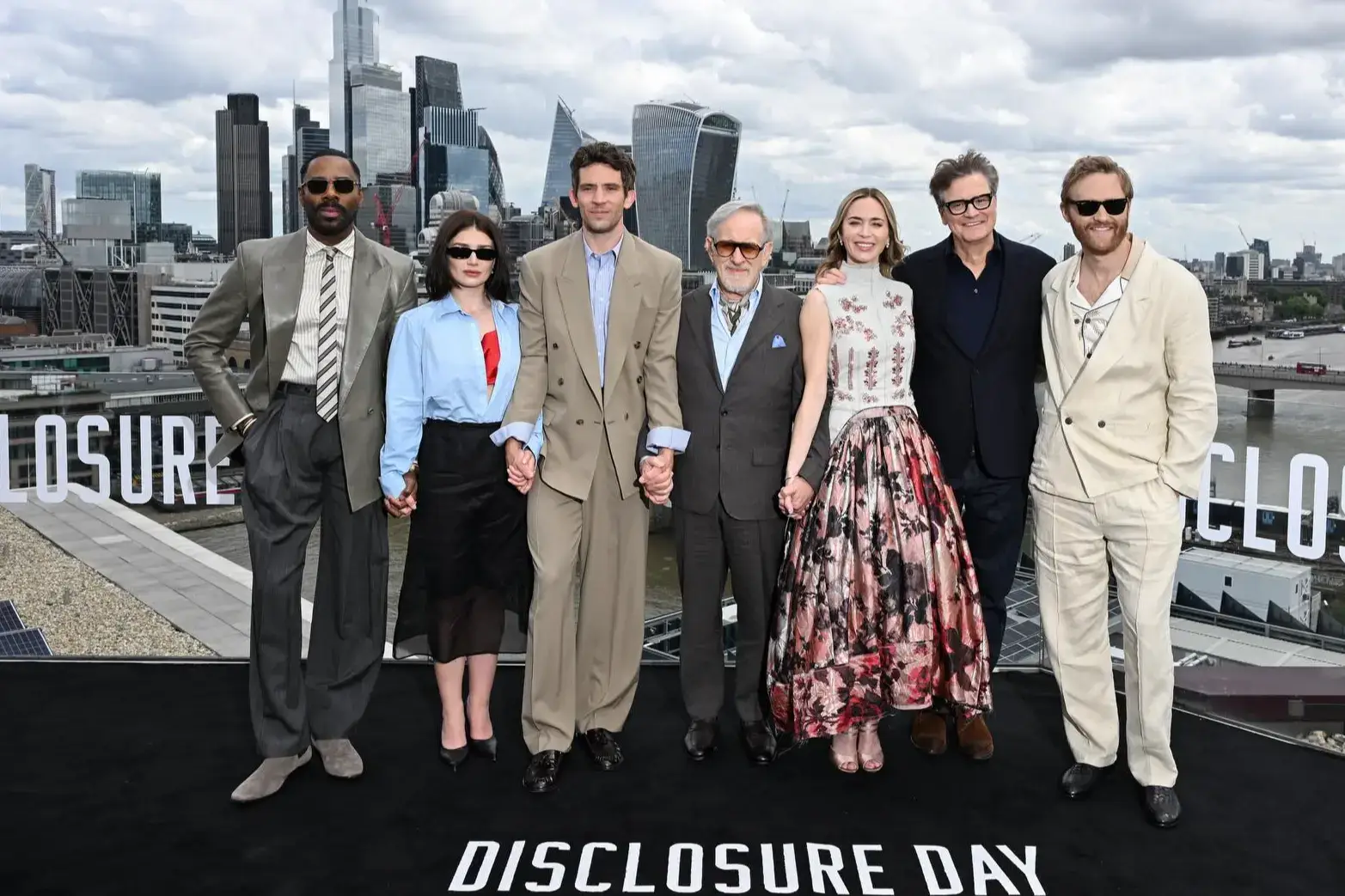
What if the truth behind an alien encounter wasn’t hidden somewhere in the stars, but locked deep inside the human mind? Disclosure Day arrives as Steven Spielberg’s return to large-scale alien storytelling, blending conspiracy, mystery, and emotional drama in a film that constantly blurs the line between revelation and uncertainty. From its opening moments, it builds tension through unanswered questions rather than spectacle alone.
Directed by Steven Spielberg, the film highlights the legendary filmmaker’s ability to balance intimate human storytelling with ambitious extraterrestrial spectacle. Across decades of filmmaking, Spielberg has continually reinvented familiar genres while remaining one of Hollywood’s defining creative voices. In *Disclosure Day*, that signature approach returns in full force, delivering not just a thrilling alien mystery but an ending that leaves audiences thinking long after the credits roll.
Spielberg Cosmic Film Legacy And Close Encounters Spiritual Sequel
Released in June 2026, Disclosure Day marks Steven Spielberg’s return to original sci-fi filmmaking and has quickly become one of the year’s most discussed theatrical releases thanks to its blend of conspiracy storytelling, alien mythology, and character-driven drama. The film also marks Spielberg’s first return to contemporary-set original science fiction in more than two decades, adding another layer of interest for longtime audiences and critics.
Few filmmakers have explored humanity’s fascination with the unknown as powerfully as Steven Spielberg. From the awe and wonder of Close Encounters of the Third Kind to the emotional heart of E.T., his films have long asked what happens when humanity comes face-to-face with something beyond itself. With Disclosure Day, Spielberg revisits that territory once again, but this time through a far darker and more unsettling lens, creating a film that many reviewers have compared to Close Encounters of the Third Kind for its fascination with contact, wonder, and human reaction to the unknown, even though it follows a much darker and more conspiratorial tone.
While Disclosure Day is not a direct sequel to Close Encounters, the thematic connection is impossible to miss. The earlier film ended with a small group witnessing peaceful first contact, leaving audiences with a sense of hope and possibility. Disclosure Day picks up that idea decades later and asks a much bigger question: what happens when that truth can no longer be hidden? Instead of focusing on discovery, the film explores the global fallout of revealing non-human intelligence to the entire world.
The connection extends beyond its themes. Spielberg and cinematographer Janusz Kamiński deliberately echo some of the iconic visual language that made Close Encounters unforgettable. Several sequences deliberately echo Spielberg’s earlier extraterrestrial imagery through dramatic skies, overwhelming scale, and moments of suspended awe, while shifting the emotional tone toward uncertainty rather than optimism, instantly recalling the wonder and mystery of the 1977 masterpiece. Yet where Close Encounters inspired amazement, Disclosure Day replaces that feeling with uncertainty, tension, and quiet dread.
If you love deep dives into massive streaming sensations, check out our breakdown of the Stranger Things 2026 Episodes Release Date | Netflix Confirms Season 2 Spinoff and Franchise Future
That shift reflects the evolution of Spielberg’s sci-fi storytelling. His earlier films celebrated curiosity, communication, and hope, while later works such as War of the Worlds explored fear and survival. Disclosure Day lands somewhere between those extremes, portraying truth itself as a disruptive force capable of shaking governments, institutions, and society’s understanding of reality.
The story follows a Kansas City weather presenter, played by Emily Blunt, and a corporate whistleblower portrayed by Josh O'Connor. After uncovering evidence of non-human intelligence allegedly concealed by a powerful organisation known as Wardex, the pair find themselves racing against a vast cover-up to expose what has been hidden. Their mission ultimately triggers the worldwide event known as "Disclosure Day," setting the stage for a thrilling and thought-provoking first-contact drama.
Adding to the film’s prestige is an ensemble cast that includes Colin Firth, Colman Domingo, Eve Hewson, and Wyatt Russell. The project also marks the 30th collaboration between Spielberg and legendary composer John Williams, whose sweeping score beautifully bridges the director’s classic extraterrestrial adventures with this bold, modern chapter.
Emily Blunt’s Meteorologist Performance And Disclosure Day’s Most Unsettling Moments
At the centre of Disclosure Day is Emily Blunt’s captivating performance as Margaret Fairchild, an ambitious and charismatic Kansas City television meteorologist whose ordinary life is shattered by an extraordinary cosmic event. What begins as a familiar "everywoman" role quickly transforms into one of the film’s most fascinating elements, as Margaret becomes the unexpected link between humanity and an unknown extraterrestrial force. The result is a performance that is equal parts unsettling, emotional, and mesmerising, with several early reviews highlighting Blunt’s ability to balance vulnerability, unease, and emotional intensity as the film’s increasingly strange events unfold.
The film’s most unforgettable moment arrives during a routine live weather broadcast. In the middle of delivering her forecast, Margaret suddenly freezes, appearing disconnected from reality. Moments later, she begins speaking in rapid clicks and strange vocal patterns that sound completely alien. What initially appears to be incomprehensible gibberish is eventually revealed to be a complex cosmic code, instantly recognised by corporate whistleblower Daniel, played by Josh O'Connor. That shocking broadcast becomes the spark that launches the film’s high-stakes mystery and nationwide pursuit of the truth.

As the story unfolds, Margaret begins displaying unexplained abilities that blur the line between psychological transformation and extraterrestrial influence, creating some of the film’s most unsettling moments. These changes include sudden fluency in unfamiliar languages and an uncanny ability to connect with people in ways she cannot explain, making her both a target and a key figure in uncovering the mystery behind the signal.
What makes Blunt's performance so compelling is the way she balances these supernatural developments with genuine human vulnerability. She captures the manic energy of a woman whose mind is being rewritten by forces beyond her understanding, while never losing sight of Margaret's fear, confusion, and determination to hold on to her identity. The character's emotional struggle grounds the film even during its most ambitious sci-fi moments.
Critics have been quick to praise Blunt as the emotional anchor of Spielberg's sprawling first-contact thriller. Reviewers highlighted the sheer physicality of her performance during the live-broadcast sequence, in which her transformation from cheerful weather presenter to alien conduit unfolds in a deeply unsettling fashion. Others pointed to her chemistry with Josh O'Connor, particularly during the film's intense chase sequences, where the growing consequences of Margaret's new abilities drive the story forward.
In a film filled with mysteries, conspiracies, and extraterrestrial revelations, Emily Blunt remains the beating heart of Disclosure Day. Her performance gives the spectacle an emotional centre, turning what could have been a conventional alien thriller into a character-focused sci-fi story that lingers long after the credits roll.
Josh O Connor, Cybersecurity Analyst And High-Stakes Whistleblower Plot
In Disclosure Day, Josh O’Connor delivers a tense and emotionally charged performance as Dr Daniel Kellner, a cybersecurity analyst whose discovery pulls him into the centre of a global conspiracy. He starts as a quiet, analytical figure working behind screens and systems, but quickly becomes the spark that ignites Spielberg’s high-stakes sci-fi thriller. His journey transforms the film from a mystery into a relentless chase built on truth, fear, and survival.
Daniel’s role within Wardex places him dangerously close to information suggesting that evidence of extraterrestrial encounters may have been concealed for decades by a powerful and secretive organisation. While digging through encrypted systems, he uncovers classified evidence that suggests the world has been kept in the dark since the Roswell incident. The more he investigates, the more impossible it becomes to ignore the truth. When he finally breaks into Wardex’s deepest archives, he escapes with stolen files and a fragment of alien technology, setting off the chain of events known as Disclosure Day.
The response is immediate and overwhelming. Wardex CEO Noah Scanlon, played by Colin Firth, moves quickly to erase Daniel’s credibility and labels him a foreign spy. Suddenly, Daniel is no longer an analyst but a global fugitive. With federal agents and corporate trackers closing in, he is forced to go into hiding with his girlfriend, Jane, played by Eve Hewson. Using his cybersecurity skills, he constantly outmaneuvers surveillance systems as he tries to survive in a world that now sees him as a threat.

Everything changes when Daniel notices a strange connection to the disturbing on-air incident involving meteorologist Margaret Fairchild, played by Emily Blunt. What the public sees as chaos and confusion, Daniel recognises as something coded and deliberate. The alien-like signals she produces match the encrypted data he stole from Wardex. This discovery links their stories and pushes both characters toward the same unsettling truth.
Critics have praised O’Connor for bringing emotional weight to a fast-moving thriller. His performance captures a man caught between fear and responsibility, someone who never wanted to become a hero but can no longer turn away from what he has uncovered. Instead of playing a typical action lead, he grounds the story in vulnerability and moral tension, making every decision feel real and urgent.
Director Steven Spielberg’s guidance also shapes the performance, encouraging O’Connor to lean into uncertainty and emotional exposure. That approach gives Daniel a raw, human edge that fits the film’s larger themes of truth and consequence.
In the end, Josh O’Connor becomes the emotional anchor of Disclosure Day. Amid alien signals, corporate conspiracies, and global panic, his story keeps the film grounded in something deeply human: the cost of revealing a truth the world may not be ready to hear.
David Koepp Screenplay And John Williams Sweeping Score Critical Review
One of the most discussed aspects of Disclosure Day has been how David Koepp’s screenplay and John Williams’ score shape the film’s identity. Reviews have praised the story's ambition while remaining divided over whether its conspiracy-thriller structure fully supports its emotional and philosophical themes. While some see a bold reinvention of the alien-contact genre, others argue the film constantly shifts between intellectual density and blockbuster spectacle, creating a fascinating but uneven cinematic experience.
Critical reception has generally been positive, though responses remain divided on whether the film’s ambitious ideas fully come together in its final act. Early reviews consistently praised Spielberg’s direction, Emily Blunt’s performance, and the scale of the concept while expressing more mixed reactions to pacing and narrative density.
David Koepp’s screenplay has been widely described as dense, ambitious, and deliberately challenging. Rather than relying on familiar alien invasion formulas, the script leans into a paranoid espionage framework shaped by corporate secrecy, institutional control, and post-truth anxiety. Many critics praised this direction, with The Hollywood Reporter’s David Rooney calling it a refreshing approach that forces audiences to actively engage with the mystery rather than passively follow it. Other reviews highlighted how the screenplay successfully blends a fast-moving corporate manhunt with unexpected theological undertones, particularly in its exploration of how global belief systems react to undeniable extraterrestrial evidence.
At the same time, not all responses have been positive. Some reviewers argue that Koepp’s complex structure occasionally becomes overloaded, with RogerEbert.com’s Brian Tallerico noting that the film sometimes struggles to maintain clarity across its 145-minute runtime. Others pointed to tonal inconsistencies, suggesting that Spielberg’s natural sense of wonder and warmth occasionally softens the darker, more cynical edges of the screenplay. This push and pull between ambition and accessibility has become one of the most discussed elements of the film.
If Koepp’s script divides opinion, John Williams’ score has received near-universal acclaim. At 94 years old, Williams delivers what many critics are calling one of his most powerful late-career compositions. The score has also drawn attention because it marks Williams’ long-running collaboration with Spielberg continuing into another original science-fiction project, reinforcing musical themes of wonder and unease that audiences associate with their earlier work together. This musical progression mirrors the narrative itself, shifting from secrecy and fear to awe and discovery.
Trending Now: Check out our most-read story of the week, the Mariska Hargitay at NBA Finals Game 3 | Inside Her Viral Referee Block and Chris Meloni Reunion
Reviewers have repeatedly emphasised how Williams’ music anchors the film emotionally, especially in moments where the screenplay becomes dense or overly complex. A recurring orchestral theme, described by some critics as mournful yet hopeful, has been singled out for giving the film its emotional heartbeat. Even in its most chaotic sequences, the score provides clarity and cohesion, reinforcing the classic Spielberg feeling of wonder that has defined their decades-long collaboration.
Together, Koepp and Williams shape Disclosure Day into a film of contrasts. One builds a labyrinth of ideas and conspiracies, while the other opens it up with sweeping emotional resonance. Whether audiences embrace that balance or not, the contrast between Koepp’s dense ideas and Williams’ emotional score gives the film a distinctive identity.
Disclosure Day Ending Explained | Television Hijack, Alien Reveal, and Final Meaning
The final act of Disclosure Day unfolds as an intense and fast-moving sequence that blends the urgency of an espionage thriller with the emotional weight of classic Spielberg science fiction. What begins as a carefully planned media takeover quickly turns into a global turning point. Dr Daniel Kellner, played by Josh O Connor, leads a group of whistleblowers as they attempt to seize control of a major television network before Wardex can silence them forever. Their mission is simple in idea but dangerous in execution. They must reach the entire world in a single moment of truth.
The plan unfolds with precision as Daniel uses stolen Wardex access codes to shut down the studio's security systems. The entire broadcast facility locks down just as armed mercenaries led by CEO Noah Scanlon (Colin Firth) close in. Inside the control room, panic rises while the national broadcast continues as if nothing is happening. Then everything abruptly changes when the feed cuts to Margaret Fairchild, played by Emily Blunt, who is still deeply connected to the alien signal that has followed her throughout the story.
Margaret no longer communicates in normal speech. Instead, she becomes a direct channel for something far beyond human understanding. Through her connection, the broadcast system is overtaken, and the hidden Wardex archives are streamed across every channel in real time. Billions of viewers across the world are suddenly confronted with undeniable proof of a seventy-nine-year extraterrestrial cover-up. In that single moment, global secrecy collapses, and the structures of control that shaped society begin to fall apart.
Once the truth is revealed, the film shifts tone in a striking, emotional way. The tense political thriller atmosphere gives way to something brighter and more spiritual. Above the studio, a massive geometric alien structure known as the Cube begins to emerge through the storm-filled sky. It descends with a calm presence that feels more like an invitation than a threat. It is not a weapon or invasion force but a living expression of light and intelligence that defies human logic.
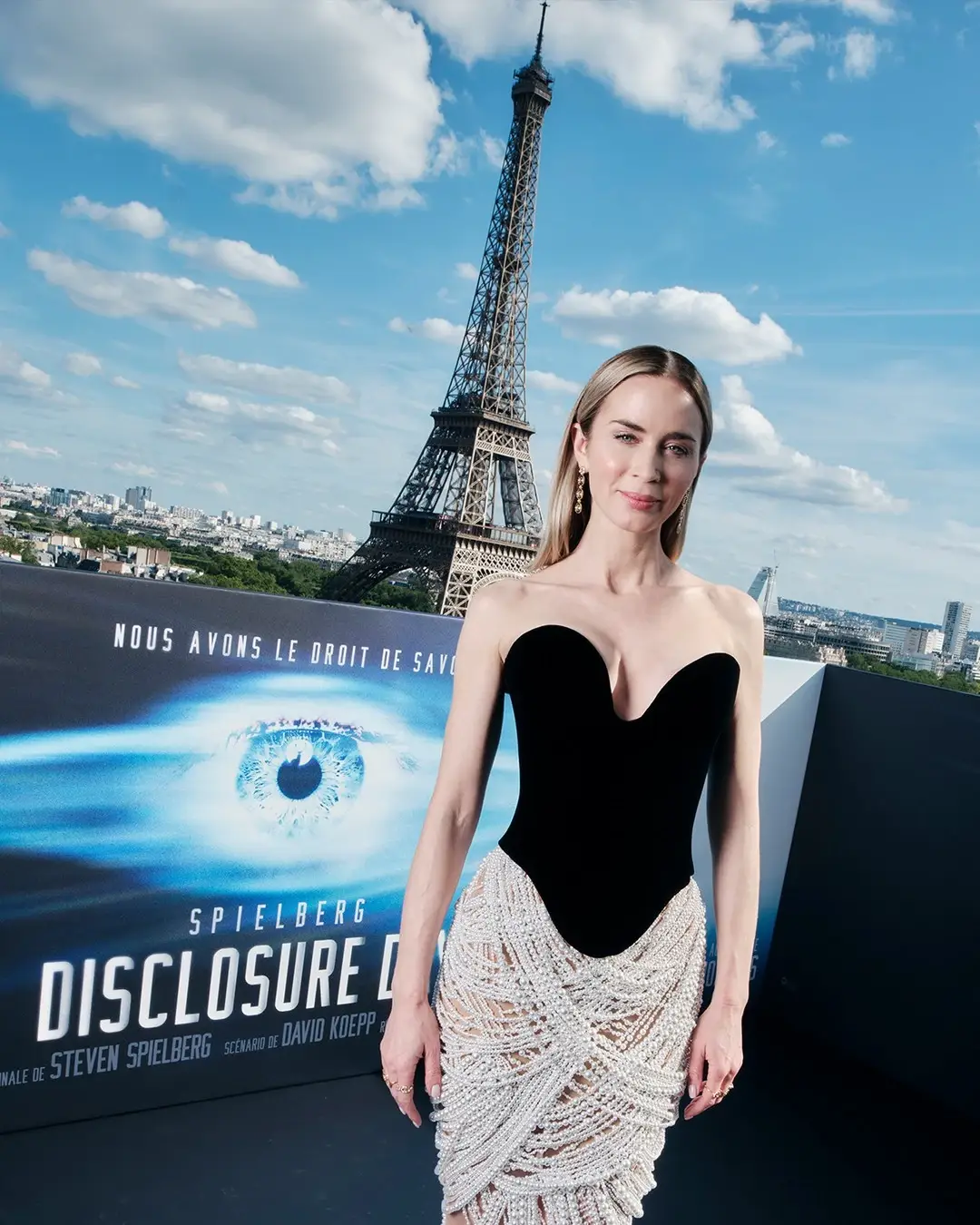
As the Cube lowers closer, Margaret Daniel and the remaining Wardex figures are drawn upward into its core. Inside, they finally come face to face with the intelligence behind the signal. The final reveal leaves parts of the extraterrestrial presence intentionally open to interpretation, emphasising communication, perception, and human understanding over a traditional alien reveal. Rather than presenting fully defined beings, the film suggests an intelligence expressed through patterns of mathematics, language, and consciousness. They communicate through structure and meaning rather than spoken words, showing a form of intelligence that reflects patience and understanding rather than force.
Read More: Stay updated with our latest features in the Entertainment Category
Everything that came before begins to reshape itself in this moment. Margaret’s earlier breakdown is no longer seen as instability but as her mind adapting to a higher level of communication. What once appeared chaotic is now understood as the beginning of connection. Rather than positioning the extraterrestrials as conquerors or saviours, the film presents them as a catalyst that forces humanity to confront itself. Instead, they ease her mental strain and transform her perception into clarity, allowing her to understand what she once could only feel.
The film closes with a wide and quiet view of Earth. Cities across the planet are bathed in a soft and radiant glow as more vessels descend gently from the sky. There is no panic and no chaos. Only stillness and acceptance. Spielberg leaves the audience with a powerful, simple idea: truth becomes transformative only when humanity is willing to face it without fear, even when it challenges everything it believes to be real.
For More News, Entertainment, Follow CelebWikiCorner.
.webp)
.webp)
.webp)
.webp)
.webp)
.webp)
.webp)
.webp)
.webp)

.webp&description=Entertainment)
.webp&description=Entertainment)
.webp&description=Entertainment)
.webp&description=Entertainment)
.webp&description=Entertainment)
.webp&description=Entertainment)
.webp&description=Entertainment)
.webp&description=Entertainment)
.webp&description=Entertainment)