
.webp)
Few Westerns have blurred the line between history and legend as effectively as Tombstone. The 1993 film brought Wyatt Earp, Doc Holliday, Johnny Ringo, and the Gunfight at the O.K. Corral back into popular culture, and turned Val Kilmer’s Doc Holliday into one of the genre’s most memorable characters.
Many of the people, conflicts, and even some of the dialogue came from historical accounts. But the film also reshaped uncertain events, invented rivalries, and simplified a complicated feud into a cleaner Hollywood story. Even Holliday’s famous “You’re a daisy if you do” appears to be a subtle rewrite of a line reported immediately after the real gunfight. So, how much of Tombstone is true, and where does history give way to legend?
The Real Doc Holliday Quote Tombstone Changed
One tiny change turned a line from the real Gunfight at the O.K. Corral into one of Tombstone’s most memorable moments. A newspaper account published immediately after the October 26, 1881, gunfight reported that Frank McLaury aimed at Holliday and said, “I’ve got you now.” Holliday reportedly answered, “Blaze away! You’re a daisy if you have.”
Kevin Jarre’s screenplay changed the final word from “have” to "do”: “You’re a daisy if you do.” Combined with Kilmer’s controlled delivery, the revised line sounds less like a sarcastic observation and more like a direct challenge.
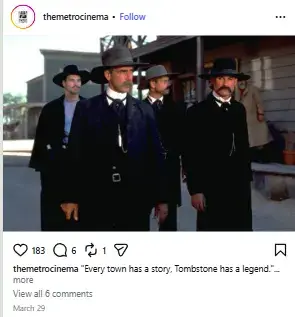
The difference may seem small, but it changes the meaning of the entire exchange. In period slang, a “daisy” could mean an exceptional or remarkable person. Holliday’s reported response was therefore sarcastic: if McLaury truly had him beaten, he had accomplished something impressive. The movie’s “You’re a daisy if you do” sounds more like a direct challenge, as if Holliday is daring McLaury to pull the trigger.
That simple change worked especially well with Kilmer’s calm, almost emotionless delivery. Instead of sounding like a strange piece of 19th-century slang, the line became a tense challenge during the final moments of the gunfight. It is one of the clearest examples of how a small Hollywood rewrite helped turn a real historical moment into an unforgettable movie scene.
“I’m Your Huckleberry”: What Doc Holliday Really Meant
Few Western movie lines are as memorable as Val Kilmer’s calm delivery of “I’m your huckleberry” in Tombstone. The phrase may sound strange to modern audiences, but in 19th-century American slang, it meant something much simpler. Doc Holliday was essentially telling Johnny Ringo, “I’m the man you’re looking for” or “I’m ready for the challenge.”
The meaning becomes clear during the film’s tense showdown. When Ringo challenges the men around him to play for blood, Doc steps forward without hesitation and says, “I’m your huckleberry. That’s just my game.” Instead of making a loud threat, Doc delivers the words with quiet confidence, making it clear that he is willing to take Ringo on.
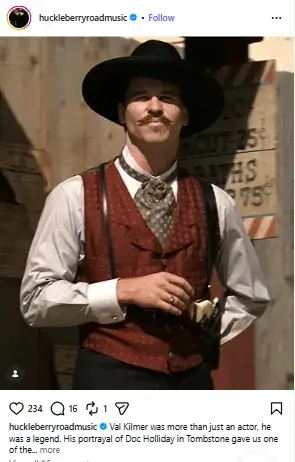
Over the years, a popular internet theory claimed that Kilmer actually said “huckle bearer,” supposedly referring to someone who carried a coffin. The idea makes the scene sound even darker, but no documented 19th-century evidence shows that “huckle bearer” was a term for a pallbearer. The screenplay says “huckleberry,” and Kilmer explicitly rejected the “huckle bearer” interpretation in his 2020 memoir, I’m Your Huckleberry. He explained the line as meaning, in effect, “I’m your man” or “You’ve met your match.”
Trending Now: Check out our most-read story of the week, the Earle Meets World | Netflix Release Time, Alix Earle Family Scandals, Cast & Bio
The expression was not invented for the film. It also appears in Walter Noble Burns’ 1928 book Tombstone: An Iliad of the Southwest, one of the influential works that helped shape the popular mythology surrounding Wyatt Earp and Doc Holliday.
So, while the “huckle bearer” theory remains a fun piece of Tombstone fan lore, the evidence points to “huckleberry.” With Kilmer’s relaxed voice and deadly confidence, the simple phrase became far more powerful than its old-fashioned meaning suggests. In that moment, Doc Holliday was not speaking in riddles; he was simply telling Ringo, “You want a fight? I’m your man.”
The line has taken on additional meaning since Kilmer’s death from pneumonia on April 1, 2025, at age 65. Although his career included Top Gun, The Doors, Heat, and Batman Forever, his performance as Doc Holliday remains one of his most celebrated—and “I’m your huckleberry” remains inseparable from his legacy.
Doc Holliday vs. Johnny Ringo: The Real Story Behind the Duel
The final showdown between Doc Holliday and Johnny Ringo is one of the most memorable scenes in Tombstone. In the movie, Ringo expects to face Wyatt Earp, only to find Doc waiting for him beneath a tree. Doc calmly says, “I’m your huckleberry,” before the two face off and Doc shoots Ringo.
The scene makes Doc and Ringo look like two perfectly matched rivals. Earlier in the film, Doc and Ringo trade insults in Latin, establishing them as unusually sophisticated and dangerous rivals. The exchange helps the movie build the idea that the two men are intellectual matches as well as deadly gunfighters.
In real life, Doc Holliday did not kill Johnny Ringo. Ringo was found dead near a large tree in West Turkey Creek Valley on July 14, 1882, with a gunshot wound to the head. The coroner’s inquest concluded that he had died by his own hand, although later writers have continued to propose murder theories.
Ringo’s death has remained a mystery because of the strange details surrounding his body. His revolver was found in his hand, while his boots were reportedly tied to the saddle of his missing horse. Such details have encouraged speculation, but they are not proof that another person killed him.
Contemporary reporting and Colorado court records place Holliday hundreds of miles away around the time of Ringo’s death. Although gaps in the record have encouraged speculation, there is no credible evidence that he secretly returned to Arizona and killed Ringo.
Stories later attributed Ringo’s death to Wyatt Earp, but the best-known version, published in I Married Wyatt Earp, has serious credibility problems, and the supposed source manuscripts were never produced. Earp also gave inconsistent accounts, at one point denying that he had killed Ringo. No reliable evidence establishes that he or Holliday was responsible.
Hollywood chose a much cleaner ending. Instead of leaving Ringo’s death unresolved, Tombstone turned it into a face-to-face duel that gives Holliday a decisive victory and brings the film’s fictional rivalry to a satisfying conclusion.
O.K. Corral Gunfight: Tombstone Movie vs. Real History
The O.K. Corral gunfight is one of the most famous moments in Tombstone, but the real shootout differed greatly from what appeared on screen. The 1993 movie turned the brief and chaotic gunfight into a dramatic Western showdown. In reality, the gunfight did not take place inside the O.K. Corral. The shooting occurred in a narrow vacant lot off Fremont Street, beside C.S. Fly’s boarding house and photography studio and several doors west of the O.K. Corral’s rear entrance, not inside the corral itself.
Who fired first remains disputed. Wyatt Earp said Billy Clanton and Frank McLaury reached for their weapons after Virgil ordered the group to disarm, while prosecution witnesses described the Earp party firing as some of the Cowboys tried to surrender. Because the testimony was divided by loyalties and several witnesses contradicted one another, historians cannot establish the opening seconds with certainty.
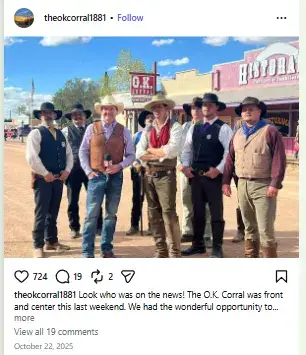
Even some of the most memorable details were changed for Hollywood. Holliday did carry the short double-barreled shotgun used in the fight. Virgil Earp had concealed it beneath his coat while the group moved through town, then handed it to Holliday before the confrontation. The movie emphasizes Ike Clanton’s cowardice, but the real Clanton was unarmed during the gunfight. He escaped the shooting and later testified about what he claimed happened, becoming an important witness in the legal fight that followed.
Facing them were Billy Clanton, Frank and Tom McLaury, Ike Clanton, and Billy Claiborne. However, Ike, who was unarmed, and Claiborne fled as the confrontation erupted and did not take part in the full exchange of gunfire. Billy Clanton, Frank McLaury, and Tom McLaury were killed, while Virgil and Morgan Earp were wounded and Wyatt Earp escaped without injury.
Another famous movie detail is the Cowboys’ red sashes. Tombstone uses them as a clear visual way to identify the group, but there is no good evidence that the Cochise County Cowboys had a standard red-sash uniform. Individual men in the West may have worn red sashes, but no reliable evidence shows the Cowboys used them as an organized gang uniform. The film turned the sash into a visual badge so audiences could instantly identify its villains.
The movie also makes the O.K. Corral gunfight feel like the end of the conflict. In reality, the shootout marked the beginning of an even more violent period. The conflict intensified after the gunfight. Virgil Earp was badly wounded in an ambush on December 28, 1881, and Morgan Earp was murdered while playing billiards on March 18, 1882. His brother’s death helped set Wyatt’s Vendetta Ride in motion.
Read More: Stay updated with our latest features in the Entertainment Category
No firearm was found on or beside Tom McLaury after the shooting, and witnesses testified that he had opened his coat shortly beforehand to show that he was unarmed. Wyatt nevertheless maintained that Tom fired two shots before Holliday killed him with the shotgun. The surviving evidence therefore raises serious doubt about whether Tom was armed but does not resolve the dispute conclusively.
The film also compresses timelines and simplifies relationships beyond the O.K. Corral. Its personal rivalry between Holliday and Ringo is largely a dramatic construction, while the Cowboys are portrayed as a more unified criminal organization than the historical record clearly supports. Wyatt’s Vendetta Ride was real, but the circumstances of several deaths remain disputed, and the film presents uncertain accounts as decisive victories. Doc Holliday did not die in a gunfight; he died from tuberculosis in Glenwood Springs, Colorado, in 1887.
The real O.K. Corral gunfight was messy, fast, and confusing, while Tombstone turned it into a carefully staged Western spectacle. That is the key difference between Tombstone and the historical record: the people and conflict are real, but the movie reshapes several moments to give them a sharper dramatic payoff.
For More News, Entertainment, Follow CelebWikiCorner.
.webp)
.webp)
.webp)
.webp)
.webp)
.webp)
.webp)
.webp)
.webp)
.webp&description=How Accurate Is Tombstone? The True Story Behind Doc Holliday, Johnny Ringo and the O.K. Corral)
.webp&description=Entertainment)
.webp&description=Entertainment)
.webp&description=Entertainment)
.webp&description=Entertainment)
.webp&description=Entertainment)
.webp&description=Entertainment)
.webp&description=Entertainment)
.webp&description=Entertainment)
.webp&description=Entertainment)